In my quest to finding peace, I always go back to two places: my kitchen and my yoga mat. Through cooking and practicing yoga, I focus on being present - or at least trying - accepting and letting go. This is a blog about my adventures as a mother, on the mat and in the kitchen, and how they all inevitably come together, as I practice consciousness and try to find balance and harmony with all that surrounds me. Buen Provecho and Namaste.
Wednesday, December 11, 2013
' Tis the season to trust
It's snowing! Lovely little flakes are fluttering in the wind. It is technically still Fall, but in Chicago, as far as the thermometer and the citizens are concerned, it's already full on winter.
And with the temperature changes come all the logistical aspects of the season: the puffy coat, the over sized boots, the slippery sidewalks, the smartwool socks, the dry skin and nose, the abrupt change in temperature from inside to outside and back, and alas, the flu.
This year, I am determined to boost our immune system at all cost so that we can hopefully avoid the abominable symptoms that come with the flu.
I am making sure I fit in my daily yoga practice even on the busiest of days. I made cranberry and apple sauce and have been eating it daily: vitamin c, vitamin a, antioxidants. I am using the neti pot twice instead of once a day, and I an diligently taking my echinacea and elderberry drops, among other measures.
Our meals are usually laden with plenty of fruits and vegetables regardless of the season, which when you mix them up can add up to a great amount of immunity boosting elements, but I also wanted to find a way for us to be consuming some probiotics on a regular basis. Even though they don't technially boost the immune system, they do help the digestive system run properly, and after getting a pretty nasty stomach flu, I figured I might need a boost in the healthy bacteria in my gut as well. However, I didn't want them in pill form, but in food form.
My husband is currently not eating dairy, so yogurt is not an option. As I pondered the question, I remembered that a few weeks ago I had gotten a beautiful head of Napa cabbage at the market. As I wondered if they would still be available this week I made the decision: if I could get another head of cabbage, I would make some Kimchi!
Kimchi is something I have always wanted to make. I enjoy eating it, and due to its natural fermentation process, it has some great bacteria (mostly Lactobacillus but there are a few others in there as well) in it that that would fulfill my probiotic wants.
The problem with making it, is that if you are used to canning, fermenting pretty much breaks all of the rules: instead of trying to kill and or prevent any bacteria from forming, you actually want to provide an environment where it will develop and thrive. When you are making jam, or even pickles, you get to taste them before you seal that jar. You know for the most part what it's going to taste like when you open the jam a few months down the road. When you are fermenting something, it will develop the flavor on its own, with the help of the ingredients you mixed together, the bacteria in the utensils you used, and the organisms that are in the air where you are making it.
Although from an intellectual, chemical and biological standpoint I can understand why, and I can understand why it's good for us, from a practical standpoint all I can think is: really? Should I really not sterilize this jar before I put this in it? Is it really ok to just leave it out here even though there is garlic in it? Am I really not going to get sick?
And it suddenly dawned on me that if I am willing to buy it at the store, in a jar, prepared by who knows who, or to eat it a random restaurant with extremely questionable sanitation procedures, why shouldn't I feel safe making it myself? The answer came as an "aja" moment. It simply is a matter of trust - or actually, lack thereof -.
My husband always calls me a "corrector". Let me correct him: It's not so much that I am a corrector, but that I am my father's daughter (he is always right) and my mother's daughter (she knows everything). However, I think the real issue with my correcting nature, is that like most of us, I just have a bit of a hard time trusting.
Sometimes I don't trust people, other times I don't trust statements (where did you read that?), and then there are those other times, when I just don't trust myself. The breakthroughs always come when I realize that more often than not, lack of trust is the direct result of the need or desire to have control - conscious or subconscious - and that I must relinquish that need or desire in order to trust. Once I do, and I am no longer in control, I have no choice but to trust - someone else, or life itself -.
Even when the lack of trust is in myself, once I give in, and I am no longer in charge, I can then surrender to whatever the task is at hand, devoting myself to it, without the constricting and limiting thoughts that come with doubt. It's as simple as that fun exercise we all did as kids where you let yourself fall in the arms of a buddy without looking back. Once we let go of the fear, the fall is both liberating and exhilarating.
A few years back I came across a sentence that has honestly changed my life: " I trust that everything will unfold as it should as I loosen my grip and allow myself to be open". For years, I have gone back to it almost daily, because the truth is, I really believe that. Yet, I have to constantly remind myself that I believe that, in order to give myself a little boost in loosening my grip, and trusting that things really will unfold as they should.
So as I thought of making Kimchi, and I researched the different recipes and variations (like with any traditional recipe, every grandmother makes it differently, and her way is the right way...), I let go of my need to control.
All I could do was mix the ingredients with care and with love, taste the mix before putting the lid on, and then waiting and watching as I let nature do its thing. As the pungent scent of fish sauce and korean chili powder filled my kitchen air, I started to trust that my Kimchi would be safe. That it would be full of lovely microscopic organisms that my body would welcome delightfully, and that above all, it would be delicious.
Trust-ing Kimchi
1 ea Napa Cabbage, sliced in 1 to 2 inch chunks
1 G Water
1/2 cup Kosher Salt
1/8 cup Fish Sauce (omit for a lighter flavor)
1/3 cup Korean Chili Powder
10 ea Garlic Cloves, minced
2 TB Ginger, minced
1 bu Scallions, sliced
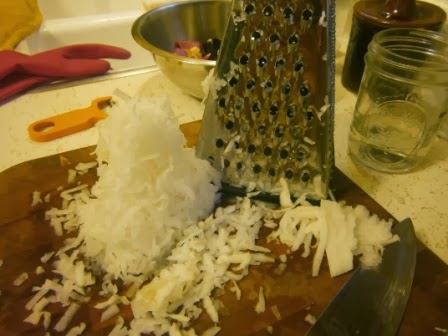
1 ea Daikon Radish, peeled and shredded
Preparation:
Dissolve the salt in the water. Submerge the cabbage in it in a large bowl, and weigh down with a plate or lid. Let sit for one to two hours. Drain the cabbage and squeeze out the excess water.
In a separate bowl, mix all the ingredients together.
Add the cabbage and using your hands (you might want to wear gloves here ) mix it very well.
Transfer to clean jars with lids.
Place in a cool, dry place (I put it in the pantry) to let it ferment. Check it daily for one to four days. Once it starts bubbling it is ready. Mine took 3 days. Once it's ready, refrigerate, and consume within three weeks. Enjoy!
Notes: There are several different ways to make Kimchi. For my first time I decided to soak the cabbage in salted water, and to not use any dried shrimp. If it's your first time as well, this recipe proved to be fool proof. The beauty of Kimchi is you can try a different version every time, and enjoy different, delicious probiotic results :)
Wednesday, November 20, 2013
Let go and let flow...
" In the end, only three things matter: how much you loved, how gently you lived, and how gracefully you let go of the things not meant for you." Buddha
I read this quote a few days ago. It resonated with so much of what I believe in. I felt a surge of peace, knowing that I have been blessed to have loved so much. In the grand scheme of things, I have lived rather gently as well. But when it comes to letting go, I am not that great, at all.
In yoga, letting go is one of the most emphasized lessons. We are urged to let go of our fears, of our expectations, of our pre-conceived notions of how things should be. We are taught to accept, and allow. To witness and to trust.
I am proud to say that when it comes to the little things, random banal daily challenges, my practice has helped me to let go. I no longer obsess over the cleanliness of my home the way I used to (although I bet my husband would argue on this one). I no longer stress too much when I miss my bus, or when I accidentally make a giant mess while I am in a hurry. I breathe, I let go, and I deal with the issue at hand in a calm and kind manner.
However, when it comes to more meaningful, life altering matters, as hard as I try, there are just some things that I find extremely challenging to let go of.
Even when my intellect can reason with me that everything happens for a reason, or that it's "good ridance" as Americans always say, I find myself holding on to moments, to words, to emotions, to experiences.
A great yoga teacher once said " how you practice your yoga is how you do everything in life". In many ways, I definitely agree with that, and to me, it also applies to cooking. So, true to form, when it comes to food, I also have a hard time letting go.
I have a hard time letting go of a specific ingredient that I forgot to get and needed (or wanted) for a recipe or meal. I have a hard time letting go when a dish that didn't come out just right. I have a hard time quieting down my ego (and my taste buds) when I forget something and overcook it, or when I completely forget to serve something I prepared for a special meal (believe it or not that has happened on more than one occasion). And I have a really hard time dealing with the fact that sometimes the kind of wholesome natural foods I eat on a regular basis are rather challenging to find.
Last week, I was in Doral, Florida. Northwest of Miami beach, this small community is best described as what my husband likes to call "strip mall Florida". I was spending a few days with my mom, my grandma and my dad, as I helped take care of my mom after she had surgery to fix a broken wrist. In my opinion, the most important element in healing both the body and the spirit, is food prepared with love.
So, one of my main jobs while in Florida was to cook for them. I knew once I left, their diet would consist of ham and cheese sandwiches, and they are all fine with that. But while I was there, I would make sure they had delicious and nutritious food to indulge in.
The first night, straight out of the hospital, everyone still very tired from their respective flights and in my mom's case from having major surgery, I scavenged through the cabinets in the apartment. This apartment is used only when people in my family travel to Miami for a few days or weeks at a time. Nobody lives there (my grandparents have had it for years) so the pantry is not very well stocked - a few boxes of wheat thins, a bag of chips, some random spices, tea, agave, honey, oil and vinegar and plenty of booze - the basics I guess. One thing it does have however, is the most amazing vintage china EVER!
I was lucky enough to find an onion and some garlic in the freezer (thank you aunt Maggie!), some pasta, and some frozen tomato sauce. I chopped the onion and the garlic, threw it in the sauce, added a cinnamon stick, some dried oregano, a little honey and some salt and pepper, and we were good to go. Not my best meal, but pretty damn good for what I had to work with.
The next morning, my dad and I headed to Publix, which was the only grocery store less than a twenty minute drive from the apartment, in search of ingredients for my task.
It's always interesting for me to see what is available at a classic American supermarket.
When, like me, you are used to shopping at your local farmers market, or at a co-op grocery, or even at Whole Foods, a regular run of the mill American supermarket can leave you a bit lost. There are at least 3 or 4 more processed food aisles than what you might be used to, there are no options when it comes to pastured or sometimes even free range meats (a lot of "natural" meats out there, which we all know doesn't mean anything...), and once you finally make it to the produce area, you may find that the fruits and vegetables displayed there are not at their best. But, as I learned when I was a volunteer at the Red Cross in my early teens, you work with what you have at hand.
As I prepared the various dishes I had decided upon (Tom Kha Ga, Curried lentils and Quinoa, Lime and Pomegranate Tuna Salad, Brown Rice) I thought about the choices I had made. That tuna was most likely not dolphin safe, those chickens were not even close to free range...The peppers weren't organic... But the fact of the matter was, there was nothing I could do about any of it. I would prepare it with the greatest care, I would pour all my love into it, and the result would be delicious, and although not as nutritious as it could be, still nourishing.
You see, if I held on to the fact that these ingredients were not the best per se, then I would have poured that negative energy into what I was cooking, and I would have depleted my energy by focusing on it, instead of using it to prepare these meals, and to focus on all the other extremely important tasks at hand (such as watching my perfect little niece nap). Instead, I really let it go. I chopped, I seasoned, I seared, I tasted, I adjusted, I simmered, I tasted again. Everything was great. Everything was tasty. Everything was nourishing.
Those meals made me realize, that if I could let go of that, I could certainly let go of all the other things I am currently holding on to.
Some are completely out of my control. Others, no longer serve me. And yet others are just really not that important. By holding on to them I am wasting precious energy that I could be using for other, more important and beneficial things. In contrast, by letting go, I will be free.
So, I choose to let go, or as my friend L told me once "Let it go, and let it flow..."
Letting Go Curried Lentils
1 cup Lentils (any kind will do)
1 small Onion, diced
2 cloves Garlic, minced
1 ea Cubanelle pepper, diced
1 TB Curry Powder (I used Jamaican)
1 TB Olive Oil
1 tsp Apple Cider Vinegar
Salt, Pepper
In a small saucepan, heat the olive oil on a medium flame. Add the onions, garlic and pepper,
and cook until they are soft and fragrant but not brown. Add the lentils and the curry, and toss around with a wooden spoon until everything is mixed well and the lentils look shiny from the oil. Add about 1 1/2 cups of water (enough so that the lentils are completely submerged and there is about 1/2 inch of water above them) and season with salt and pepper. Taste the liquid and adjust the seasoning accordingly (you can add more curry if needed). Bring to a boil and immediately turn down to a slow simmer. Simmer gently until the lentils are cooked through (they will still be whole, but will be soft when you try them). Add the vinegar and taste. Add more if needed.
Serve with some cooked quinoa. You can garnish with chopped cilantro and pomegranate seeds if you wish.
Friday, November 8, 2013
Take only as much as you give, and always give back more than you take...
A few years after I started practicing consistently, these words presented themselves to me during meditation one morning. Ever since, I have closed my practice with them, contemplating all the different situations to which this sentence applies to: relationships, my body, my soul, the earth....As well as trying to apply them to as many of them as possible.
We live in a world where we are constantly judged by how much more we have and how much we can: how much more can we buy, how much more can we work, how much more can we fit, how much more can we do. Our worth or our success seems to be measured by how much in so many ways.
But rarely is how much we are giving back considered. How much do we give back to our bodies, for kindly operating the way that they do every day so that we can in turn do more?
How much do we give back to our loved ones for everything that they do for us? How much do we give back to our bosses, or our employees, or our coworkers? How much do we give back to our planet?
And what is the relationship between how much we take and how much we return? Those words remind me daily to try and balance that energy. To consider how much I am returning, and not only how much I am taking, for
" Your worth is not measured by what you have, but by what you give".
Years after these words entered my life, on a morning like any other, as I closed my practice and repeated the mantra sending its sensory vibrations into the air, one of them shifted. Instead of "give" the word "need" nestled herself in there.
Take only as much as you need, and always give back more than you take...
huh... Interesting...
I pondered how this change affected the meaning of the sentence. I considered how much I take. Do I take only as much as I need? Not really... Do you? Probably not... And again, to how many areas of my life can I apply this sentence? Relationships, check; work, check; my body, check; the world, check.
I now change the word randomly, depending on what is currently arising in my life, and a few days ago, while I was at the farmers market, I was able to practice what I preach to myself everyday.
It was probably the last outside market of the season. The fall is in full swing, with rainbows of leaves fluttering in the wind everywhere I look, and yellow, brown and silver blankets crunching under my feet in every corner. But it is getting cold. Really cold. Winter will be upon us soon (maybe sooner than some want it to) and not only will the market move inside, but there will be less and less fresh produce every week.
So, as I walked through the stalls, and saw the many fresh colorful vegetables still available, I wanted to get them all. I stood in front of the most beautiful yellow carrots I have EVER seen, and picked up a bunch. As soon as I touched them I remembered I had just bought a bag of carrots two days prior at the store. I really don't need these, I thought as I carefully placed them back on top of the stack, while the other voice in my head kept telling me how absolutely beautiful they were, and how sweet and delicious they must be. The next farm had some young fresh ginger. Gorgeous! This would be great for a chicken stir fry! Wait isn't there an old shriveling piece of ginger in the crisper? Yes there is indeed...
Food is one area of our lives where we pretty much always take more than we need (and than we give for that matter). On a large scale we are not taking proper care of the earth and the soil, we are not giving back to the people growing our food (proper wages, political support, etc. ...) we are not even consciously thinking about where our food comes from and what is going to happen because we keep taking more than we need and give.
On on a small scale, there is usually much more than we need on our plate, in our pantry, in our refrigerator. My friend P's mom used to say that throwing away food is like throwing away money, but that no one would throw away a $20 bill. She was right. Money, energy, resources...
Yet, we always tend to over buy, or cook more than necessary, or just simply forget that last little whatever we had in the fridge until it has gone bad. Meanwhile, while we bathe in this surplus of plenty, there are so many people and places that don't have enough. It's not a matter of guilt, it's a matter of respect.
I think we really need to reconsider what we put in the cart, in the bag, and on the plate, and my market experience reminded me to do this as often as I can.
Tonight I prepared a lovely chicken stew. I used up the old ginger, and some sweet potatoes and cilantro I had from the previous week's market. I used some leftover coconut milk and miso that were hanging around in the fridge. I used the carrots I had bought at the store, and last but not least the colorful peppers, last of the season.
I was able to take my mantra off the mat and into my kitchen, and in return ended up with some delicious food, and my crisper is now empty, ready for next week's market bounty.
I hope this will inspire me to " take only as much as I need, and always give back more than I take" in many other areas of my life, one small step (or chicken stew) at a time...
Mantra Chicken
6 ea Chicken Thighs, skin off
1 ea Onion, sliced
4 ea Garlic cloves, minced
1 TB Chopped ginger (fresh or shriveled)
1 ea Sweet potato, cut into 1" chunks
5 ea Carrots, cut into 1" chunks
8 ea Small mixed peppers, sliced (or 3 large ones)
2 cups Coconut Milk
2 TP Miso
2 ea Limes, juice and zest
1 ea Orange, segments and the leftover juice
1/2 bu Cilantro
Note: The miso is salty enough on it's own, so I only salted the chicken. Depending on what miso you use or how much you add, you might need to also salt the vegetables as you sauté them.
In a blender, mix the coconut milk, cilantro, lime juice and zest, orange segments and juice and miso until thoroughly blended. Reserve.
Pat dry the chicken thighs and season them with salt and pepper.
In a hot skillet sear the thighs in coconut oil until golden brown on both sides. Set aside.
Add the peppers and cook until the peppers are soft but not brown. Add the sweet potatoes and carrots and cook for about two minutes, stirring often.
Monday, November 4, 2013
Change is the only constant
Growing up in an island in the Caribbean, one rarely experiences seasonal change. Sure, there are certain flowers that bloom in May, and certain fruits that do best in the Summer, but it's pretty much hot and muggy all the time, and the vegetation is lush and colorful year round. Maybe because of that, I have always been fascinated by the changing seasons. I remember my first fall in Hyde Park NY. It was so energizing and fascinating to see the colors change almost daily, and to see in one street, several different colored trees, and the contrast of their leaves against the blue or grey sky. We lived close to a national park named Burger Hill, and I would go on early morning hikes to see the foliage from the top of the hill. Breathtaking.
When I moved to San Francisco, although the weather patterns were quite different than those of the island, the seasons were still not very pronounced when it comes to temperature. Food, however, was a completely different story. I learned to recognize the seasons based on what fruits and vegetables were available at the farmers market, and as years passed, and I became more and more familiar with them, I was able to anticipate the arrival of some of my favorite based on what month or week it was.
Eating seasonally and locally have become quite the trends in our day and age. It seems as if both words are thrown at us left and right in devious marketing schemes, meant to promote companies and benefit shareholders.
However, eating locally and seasonally really is good for us: If we really try to go back to basics and focus on procuring the bulk of our food from local sources we will therefore support small businesses and our local economy and community. And as far as the seasonal goes, we can get so much more from our food by committing to enjoying what is available now.
Let me explain. I grew up in an island where apples can't properly grow. Due to imports, we could buy apples back home. My mom rarely did, but my aunt always did. Falling true to the human adage of "the grass is always greener" my brothers and I always wanted apples. However, I don't actually remember ever enjoying one until I finally had an apple from an orchard in Vermont. The ones from my childhood were bruised and mealy, and the skin would peel off from the flesh when you bit into them. They were dry, and honestly didn't really taste like much (no comparison to our sweet, juicy, flavor exploding mangoes, papayas or pineapples...). So, eating apples in the Dominican, that have been picked weeks prior to being sold, hundreds or thousands of miles away, is not a very flavorful experience.
On the nutrition front, we are on the same boat. When fruits and vegetables are at their peak of ripeness, they are at their fullest of nutrients. From a biological standpoint, if allowed to grow and mature on the plant, they will develop the most nutrients possible, indulging in their natural processes, taking what they need from the soil, water and sun in order to thrive. The moment they are picked, their nutrient content starts to slowly diminish, as they no longer have these sources of energy to allow them to live. Basically, once they are picked, they are dead. And the closest you can eat them to when they are alive, the most you can get from them.
Then there is the variety aspect. When we always eat the same things, we always get the same nutrients. So in order to meet most of our nutritional needs from our food, it is imperative to eat a variety of foods. If we eat seasonally, once again, there is no choice but to switch things up. In doing so, not only do we benefit from a health point of view, but also from a creativity stance. Much like the changing seasons, which make you notice a tree that you never had before when it's in bloom or when it's leaves are changing from a certain shade of green to countless shades of yellow or orange, eating seasonally makes you get out of your comfort zone and eat fruits and vegetables that you might have never thought of before, and in turn discover something you might love. And then, you get to enjoy it for the season, and look forward to next year, when it shows up at the market again.
Last week, there were some chestnuts in the CSA box. I have probably had chestnuts only a handful of times before, and it has almost always been at a restaurant. Having no idea how to approach the hard shelled little balls, they have always been a mystery to me. A very delicious one, but still, a mystery. I remember my first thanksgiving in the states, at my friend E's family's home in upstate NY, we roasted some chestnuts. For whatever reason, the procedure completely escapes my mind, and all I can remember about the cooking process is looking at E's back as he pulled the chestnuts out of the oven, their sweet scent filling the air.
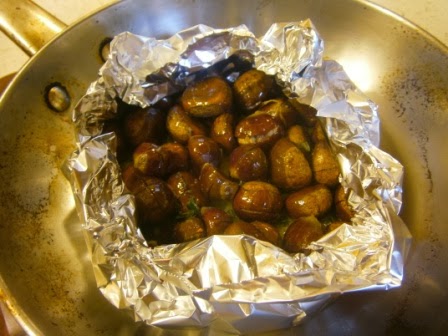
This week, more chestnuts arrived. I decided to tackle the task at hand and researched a bit on the best way to cook them. To my surprise, it's not time consuming or hard at all. After about 10 minutes of preparation, and 45 minutes of roasting time, I had some amazing roasted chestnuts to snack on. I was happy I finally challenged myself to cooking them.
Below is the recipe for this tasty little treat. I hope this post will encourage you to notice your patterns and habits, in relationship to both food and life, and to try to break at least one of them, at least once. You might be pleasantly surprised from what you might find.
Roasted Chestnuts
2 handfuls Chestnuts (sorry, that was my measurement...)
2 TB Butter, melted
1 sprig Rosemary, coarsely chopped
Salt and Espelette Pepper to taste (you can use cayenne or paprika instead)
Preheat the oven to 400.
Using a small, but sharp paring knife, core the chestnuts on their round side, forming an x.
Submerge them in a bowl of hot water (to help steam them). Drain and pat dry. Line a cast iron pan with a large piece of foil. Toss the chestnuts in the butter and rosemary. Generously season with the salt and Espelette.
Place in the middle of the foil piece, and crunch up the edges to form a pouch, leaving a large opening at the top.
Bake for 30 to 45 minutes, or until the skins start to peel off from the inside of the chestnuts. Enjoy!
Wednesday, October 23, 2013
Good croissant, bad croissant
This morning, I arrived bright and early at the studio. My shift begins at 7:30, and I was opening the doors at 7:23. As I took in the morning energy of the lovely neighborhood that is Lincoln Square, with all its residents getting ready for their day, walking to the train or walking their dogs on their way to grab their morning cup of coffee, I remembered that a French pastry chef works at the corner coffee shop.
As some of you know, I am always on the search for a good croissant. Always... I have been tipped off by my coworkers that the ones for sale at the coffee shop are divine. So, even though I brought enough food from home to feed myself through my multiple hunger pangs today, I decided I would splurge and treat myself to a croissant and do a little reconnaissance of the talented pastry chef's baked goods.
As I opened the door to the shop, the smell of freshly brewed coffee and the sounds of the espresso machine being put to work again and again delighted my senses. I immediately spotted the croissants, strategically placed in the corner of the display case, facing the door as you enter the space. They did indeed look legit. Perfectly golden brown. My gluttony sensors had been awoken.
I walked up to the register and patiently waited for the girl behind the counter to finish pouring a fresh cup of coffee to the lady in front of me. She had brought her own reusable stainless steel cup. I appreciated her effort, as I knew that not only was it better for the environment, but her coffee would also taste much better out of her reusable mug, than it would out of a flimsy paper cup.
After exchanging courteous greetings with the clerk, I asked her for a plain and a chocolate croissant. I figured I would try them both out, because, why not? She placed them both in a brown paper bag, I paid and went back to the studio to begin my work day.
Once the first class of the day was signed in, I washed my hands, and set my self up for breakfast. I spread my orange cloth napkin on the counter, and set both croissants on top of it. I poked them each, and the dough slightly crackled under my fingers, releasing a few bits of brown buttery goodness onto the napkin. Good sign. I decided to start with the plain croissant, since in my opinion, even a mediocre chocolate croissant is good, but a plain croissant can be great or awful, depending on the level of skill, love and craftsmanship of the baker.
I pulled at both ends of the crescent shaped bread, to break it in half. To my disappointment, the layers of dough didn't slowly unfold from one another the way they do in a perfect freshly baked, buttery croissant. It had a lot more resistance than I was hoping for, and my suspicions were confirmed once I took the first bite. Instead of melting in my mouth, this croissant was a bit chewy, almost gooey. Oh well, it was still a croissant. I ate half, as I had already decided upon purchasing it that it would be my breakfast, and then I moved on to the chocolate. Once again, not as fresh as I was hoping for... I put both halves back in the bag, and within minutes I felt incredibly full, and a bit gross.
As the morning progressed, I couldn't shake off that sensation from my stomach, and I beat myself up several times for overindulging and purchasing two different pastries, when I actually had breakfast in my lunch box. I didn't feel good all day that day and I wondered many times if it was just a bad day for the baker, and I chose the wrong day to try out the croissants.
Then I thought of how I tend to correct myself (and others) for the misuse of the word "need" ( not to be confused with the word "want"). And it dawned on me, that sometimes, we could really benefit from not only using the correct word as we express our desires and feelings in sentences, but also of considering, before making a choice, if it is a need or a want, and if we really want to follow through with it.
Had I taken the time to consciously debate whether or not to purchase the croissants, I would have ended up talking myself out of it as I already had too much food for the day. And perhaps on another day, when I hadn't brought food and was hungry, I would have gotten a croissant, and it would have been wonderful. Instead, I now think of the croissants at the corner coffee shop as just ok, and due to my hard headed nature (thanks Dad :)) there is a good chance I won't try them again any time soon.
A few days later, as I was teaching a class, I noticed my student trying to force himself into extended side angle pose (Utthita Parsvakonasana). Although he could technically do it, he wasn't really ready for it. Instead of his spine lengthening, and space being created around his rib cage and his chest, in the way that a body who is flexible and strong enough to be in the full expression of this particular asana will , I saw the opposite action occurring, starting from his hips, and following all the way to his neck and jaw muscles. There was crunching, and tension, and absolutely no length whatsoever.
" Just because you can, it doesn't mean you should" I heard myself telling him. " You can get more benefits from this pose if you back up a little, instead of forcing yourself into it through ambition. Listen to your body, and accept where it is today, without comparing it to yesterday, or to someone else's". As he backed up, and rested his forearm on his thigh, instead of reaching for the floor with his hand, I saw his chest open, his spine grow, and his face relax. And I immediately thought of the croissants: " Just because you can, it doesn't mean you should..."
The truth of the matter is, we almost always react rather than act. And of course, sometimes, it's ok - or even good - to do something just because we can. But in most cases, we could really benefit from having an internal dialogue in which we ask ourselves the purpose, as well as the possible consequences of our actions. By really considering our actions and choices, we could prevent many potential mistakes, and save ourselves - and often times others - a lot of time, trouble, and even money.
If we practice being present, and a bit of awareness towards ourselves, we might find that in many cases, even though we can, we probably really shouldn't, and will definitely feel a lot better knowing that we didn't...
Wednesday, October 16, 2013
It just tastes better....
I usually wake up before my husband does. I make myself some coffee and then sit on the little window nook and read while I slowly wake up.
My coffee is usually wonderful (some days a little better than others) with the bitterness, acidity, earthiness, and the sweetness from the raw sugar delighting my taste buds as I sip.
Some mornings though, J rises before I do. And on those mornings, there is an extra element to the morning coffee routine, that for whatever reason, just does not register when I make it for myself: the aroma of freshly brewed coffee lacing the air.
I remember the first time I went to Napa with the family I used to nanny for. They own a lovely little cottage in St Helena, and the guest bedroom is outside, off the patio. I was awaken from a restful sleep by the smell of coffee traveling from the main house, all the way to my nostrils. Seven years later, when the smell of fresh coffee wakes me up, I still think of that moment, and of how wonderful a way to wake up this is.
Two mornings ago, as I lay in bed trying to summon the strength to peel my body of the sheets, the same intoxicating perfume sneaked itself in the bedroom. And then it hit me: it never smells like this when I make it for myself!
Now, I'm sure there is some scientific (neurological, psychological or whatever) explanation of why this is. My theory however, is that everything always tastes better when someone makes it for you. Because when you are eating or drinking something that someone else made for you, you are dwelling in gratitude, either for that person, or for the simple fact that you did not have to make it yourself.
Since my morning coffee is as much ritual as it is the plain need for caffeine to aid me in waking up, the smell of it plays a great role in how wonderful the experience is. And the fact of the matter is that it just tastes better when J makes it for me...
And when we do get invited over for dinner, we always enjoy it so much more than when we make it ourselves. As a cook, being able to sit down in someone's home, and eat a full meal not prepared by you, is a humbling and heartwarming luxury.
It's not about who can prepare the best roast. It's about how much care and intention went into it. And when I speak of intention, I don't just mean the intention of the people preparing the meal, but also the intention of the folks who are consuming it. I am convinced that gratitude makes that food taste better, and be better for you. Which made me question why we are often so quick to thank others, yet so slow to thank ourselves...
With this in mind, for the next few mornings, as I sip my coffee that I will have made myself (my new schedule has me rising before sunrise, so there ain't no way J is making my coffee) I will breathe in gratitude.
For hearing my alarm, for having two legs that can get me out of bed, for having a reason to do so, for having a fully functioning brain and body that can make my coffee for me, for having delicious fresh Dominican coffee beans hand delivered by my mom, for having multiple vintage coffee mugs, hand selected at various thrift shops around the country, that brighten my day when I see them, and a lovely little window nook, above a fully functioning radiator, with a view of Paris and the Seine river (from some really old wall paper but hey... still Paris) where I can enjoy this precious nectar while I greet the new day.
I will think of J, and his loving kindness, and sip in gratitude for having found a mate who once in a while, is willing to make my coffee for me.
I am certain that bringing gratitude to the equation, and intention to my routine, will open my heart, and maybe even my olfactory receptors, and the room will instantly fill with the bittersweet scent of freshly brewed coffee.
Sunday, October 13, 2013
The abominable eggplant part 2: a lesson in acceptance.
One of the perks of my new job is free yoga classes (I know!). A few days ago, I took a class with a lovely woman named Dede. She is fun, joyful and energetic, and has one of those smiles that literally light up the room when she walks in. As she guided us through the sun salutations, to the beat of the carefully selected soundtrack she was playing for us, I opened my arms in Virabhadrasana and the word "receive" showered my whole being. As we danced through her sequence, syncing breath and movement, every time our arms were either up or laying on the floor, I found myself facing my palms towards the sky and feeling that word, which by now had turned into an emotion, enveloping my body and soul: receive.
On my way home, a crazy man decided I was the person that he wanted to chat with while waiting for the bus. At first, I kindly smiled at him, but tried to keep reading. Then the word came back to my mind: receive. I closed my book and engaged in conversation with him. Once we parted ways I felt lighter.
Instead of trying to fight a battle that I was never going to win (trust me, he wasn't going to stop talking just because I wasn't listening, he was completely coo coo) and creating aversion by focusing on how I thought things should be (me catching up on my reading while waiting for the bus) I surrendered and accepted the moment as it what, and in turn experienced a sense of calm and harmony with the world around me.
Later that day, as other little annoying or unwanted things arose, the word kept coming back to my mind, inviting me to accept, for it is all part of the path.
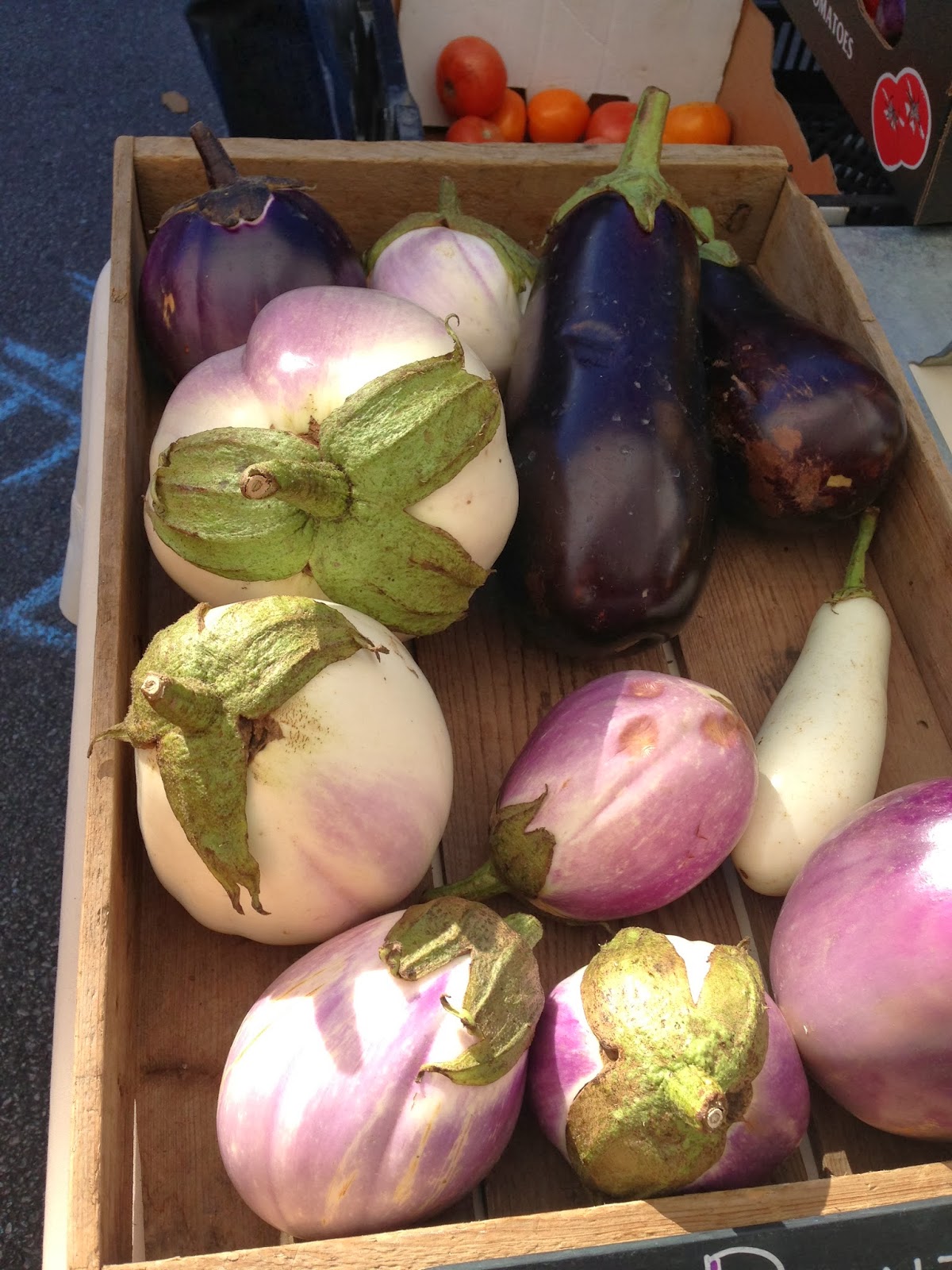
Which brings me to the abominable eggplant. As many of you know from a previous post, this has never been one of my favorite vegetables. And in true "Murphy's law" fashion, the CSA I signed up for grew more eggplant than anything else this summer.
As a matter of fact, it's October and those eggplants are still showing up every Wednesday. The first few weeks, I would ignore them, and then reluctantly throw them into a stew when they were almost going bad. Or roast them, and chop them up and freeze them for when the winter is here and there are NO vegetables. I even made ratatouille, as peppers and tomatoes were also abundant for a few weeks. But in all those preparations, I still did not enjoy them.
After my "receive" revelation during practice, I changed my attitude towards my eggplant friends. I decided to receive them with love and affection. If they were showing up, they were meant to be in my diet, so I should accept them, and find a way to enjoy them. What do I love that is made with eggplants?
Well. I LOVE dips, so in the past, when eggplants would somehow infiltrate themselves into my kitchen, I would always make melitzano salata, the Greek eggplant spread.
http://www.offthematandintothekitchen.blogspot.com/2012_09_24_archive.html
However, since it was the only thing I ever made with eggplants, I was a bit tired of it, so
I decided to find out what other cultures eggplant dips were all about, and before I got my next inevitable eggplant delivery, I stumbled upon David Lebovitz's post on Baba Ganoush. Bingo! (http://www.davidlebovitz.com/2008/07/baba-ganosh/ ). His recipe was extremely simple, and other than waiting for the eggplants to roast, it was also pretty quick.
A few nights ago, as I enjoyed my lovely eggplant dip, I thought of how our labels limit us from receiving the gifts that the universe might have in store for us. By thinking and saying that I don't really like eggplant, I was stifling my creativity to cook something with it that I would actually enjoy.
In the same way, when we become attached to preconceived notions of ourselves , either inflicted to us by our parents and teachers, or by our past selves, we limit our ability to experience the full spectrum of our character, and even our choices. This is also true for the labels we choose for others, our relationships or even mundane tasks in life. Once again, by holding on to the idea of how we think things should be or are, we either create aversion to how they truly are, or prevent ourselves from experiencing how they could be.
When I first met J, due to preconceived notions I had of him passed down from some mutual friends and acquaintances, I didn't think much of him. Had I not shifted my perspective, I might have missed out on one of the greatest gifts I have ever received: our love and our marriage.
Subscribe to:
Posts (Atom)